Tuesday, May 26, 2015

My heart is full today.

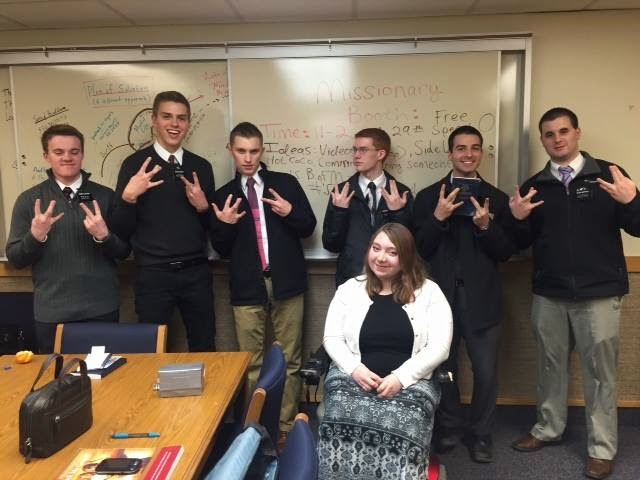
This morning, an investigator asked me if I'm "a missionary for two years, like these guys," and I got to tell her no, I get to do this for the rest of my life if I so choose. I am pretty sure that response confused the crap out of her, but it totally made my day.


I would love to be a full-time missionary. I think that's pretty obvious to anyone who knows me at all.


Some of the best times of the past few years of my life have been while talking with and listening to people who've found themselves in a place where they need to learn about the gospel of Jesus Christ.


My understanding of the Atonement, my love for my Savior, my ability to feel compassion for strangers I never would have known had they not taken the time to listen to a Crazy Jesus Girl... all have been expanded beyond what I could have imagined.


Without ever wearing a nametag (well... with my own name on it), I've gotten to dedicate about as much of my time and effort as I can to doing the Lord's work. I've street contacted (poorly), tracted (awkwardly), taught gospel principles (with a whole lot of divine help), and I dearly hope I've in some small way been used to help someone on their journey to a closer relationship with their Father in Heaven.


If it had been 100% up to me, would I be serving a full-time mission right now? Well, of course. But am I happy that it wasn't up to me? Of course.


I'm never going to be called and set apart as a missionary, but that's no loss for me. I get to do "missionary work" every day. I'll never be released. The ways in which I go about serving my fellow man will change -- there's no way I'll get to spend so much time actively working with the missionaries in Utah! -- but there's no time limit on my ability to be "Sister Heather."


As a direct result of not being healthy enough to serve a mission, I've learned how to be a missionary wherever I go. I've created friendships that I've been promised will last throughout eternity. I've grown to love the scriptures and to rely more fully on Christ. My heart has been broken and then healed more perfectly than it could have been before.


Like always, God's plan is so much better than anything I could have come up with for myself.


Monday, May 25, 2015

What comes next? Not a clue.

After five (sort of six) years of college, I'm the proud owner of two undergraduate degrees. (Woohoo!) 

The rational question, and thus the one I get asked approximately 50 times a day, is "What are you doing next?" 

I wish I had an answer to that, I really do. 

Right now, I have a pretty cool part-time job doing GIS analysis -- AKA "what I majored in, like maps and stuff" -- for a small business here in Morgantown. I'm enjoying it, but it doesn't provide the income I need to justify staying here long-term... and truth be told, I feel like it's time for me to move on. 

Over the past year or so, I've felt pulled in a whole bunch of different directions. Washington. Arizona. Utah. A different part of Arizona. Philadelphia (please no). Utah then Arizona. 

Every time, I've obediently thrown myself into going where I think I need to go. (Even when it's Provo.) And every time, it's stopped feeling right. I am pretty familiar with that feeling. (See also, that time I almost served a mission.)

I've prayed. I've fasted. I've gotten about a dozen blessings. (Okay, not specifically for that, but still.) I've prayed some more. Nada. I know Heavenly Father is there and that He cares what happens to me, but He doesn't seem too driven to tell me where to spend the next X months of my life. 

Meanwhile, I've been sick. Like, lost-track-of-how-many-times-I've-been-in-the-ER sick. For a few months there, I worried that I wouldn't be healthy enough to do much of anything after college, but I've finally begun to feel better enough to consider a future beyond the walls of my bathroom or the hospital. The persistent IV bruise on my left forearm is healed up and everything. Hallelujah. 

So, between being sick and not getting any crystal clear personal revelation, I've had a tough time figuring out what it is that God would have me do, or even what I would have me do. I still don't know.

As of today, I'm cautiously pursuing the idea of moving to Utah for a few months and then maybe Tucson. I don't have any compelling or even interesting reasons. I know exactly 0 people who will be in Tucson, and not a whole lot more than that in Orem. All I know is that Morgantown isn't the place for me to live out the rest of my life, so I might as well go somewhere else and see what happens. Baby steps, I guess, like stepping into the fog. 

I don't love the fog, but I love what happens when I continue moving forward. 

Saturday, March 28, 2015

The Importance of Visibility

The other day at the mall, I saw a girl, probably in her late teens, who was in a wheelchair. 

That isn't terribly unusual - I see people with physical disabilities two or three times a week. We really are everywhere: we attend school, we get dinner with friends, we go to bars, we shop for groceries, we go to work. 

What was remarkable about this girl was that she had all the signs of being newly disabled. Her wheelchair had the name of a local in-patient rehab hospital on the back, and she was being doted over by two other women, probably her mother and sister. I don't know anything about her life or her disability, so she might be only temporarily disabled, but I did notice that she was watching me. 

It made me think back to the beginning of my life with a wheelchair. 

At eleven years old, I hadn't had many experiences of seeing people with significant physical disabilities as they lived their normal lives. I had never seen a person in a wheelchair do the normal things that I do every day, let alone get married and have a family and a career. Without seeing people who were like me doing those things, I thought they couldn't be done. 

Throughout my teenage years, I sought out examples of people with disabilities living normal lives. There weren't very many: a high school teacher, a handful of other teenagers with the same insecurities as myself, and a few lifestyle articles in disability-related magazines. There were only a handful of people like me on TV or in books, and those that were there had brief appearances, often as a plot device.

The impact this had on me was significant. I spent a long time believing that I was doomed to live a lonely life without any of the independence I've now gained. For almost a decade, I was in a deep depression. I couldn't see that I had anything to live for, because I couldn't see hope for a good, "normal" life.

Life is different today. I've discovered examples of people with disabilities living happy, fulfilled lives, with families and careers and joy. I know that my life can include the things I wished for when I was younger.

The thing is... it shouldn't have taken a decade for me to understand that. Nobody should wake up from surgery or live their entire childhood with a disability without knowing that their physical conditions don't prevent them from living the lives they want to live. Nobody should have to seek out examples of people like themselves holding a job or going to college. Those examples should be readily available.

Visibility matters.

Sunday, March 22, 2015

To Be Humble, or To Be Humbled?

There's a phrase I've heard a few times in the past few months that's really sticking with me.

"Be humble, or be humbled."

It's an interesting thought to me. The Lord has called His people to be humble, and it's going to happen. The only question is whether we'll choose to humble ourselves, or whether we will be humbled by an outside force.

At Friday Forum this week, the speaker spoke about entitlement and humility. He asked us to take a moment to think of the most humble person we know, and then describe the other traits that person has.

Here's the list we came up with:
  • Elderly (not always, but often!)
  • Spiritually sensitive (or a spiritual leader)
  • Rarely talk about themselves
  • Service-oriented 
  • Grateful 
  • High self-esteem
  • Quiet, but not fearful
  • Content with what they have
  • Good leadership skills
  • Patient 
  • Selfless
  • Penitent 

This is a pretty fantastic list of personal characteristics for anyone to develop. I'm making it my goal to work on them myself... I have a long way to go.

Grandma, c. 1992
When I look at that description, I think of my grandmother. I don't know very much about her life and what's shaped the personality I've seen during my lifetime, but I deeply admire her for having all of
the qualities listed. She isn't a member of my religion, but she's whole-heartedly dedicated to Christ. Even in times of great distress (she lost her second husband and her mother within a month of one another; she's survived breast cancer; she had an obnoxiously ungrateful teenage granddaughter), I've never heard her complain or express anger or ingratitude. Instead, I've seen her study the gospel of Jesus Christ, dedicate herself to serving others, and endure her trials with patience. When I think of the kind of person I want to be, she's the best example I can imagine.

For me, on the other hand, humility hasn't taken root. You might think that after 11 years in a wheelchair, being a 4'10" grown woman, being consistently sick for several years, etc, I would have humility down pat. Spoiler alert: NOPE! I am one P-R-I-D-E-F-U-L woman. I can be literally laying on the ground unable to get up and be entirely unwilling to ask for help. (This happens often. Maybe I should be learning something.)

(There's a missionary serving in Morgantown right now who frequently tells me, "Don't be embarrassed." I fall down and have to call him to come help me up pick me up... "Don't be embarrassed." I pull over while driving because I'm afraid I'm going to puke on the steering wheel... "Don't be embarrassed." I'm considering hiring him to follow me around saying that at opportune moments after his mission. That's a job any 21-year-old man would aspire to, right? ... What if I pay him in M&M brownies?)

It seems to me that my life is full of reminders to be more humble... I'm actually pretty certain that pridefulness was one of my premortal flaws, and part of the reason I'm so physically frail is that it gives me the opportunity to learn humility. I came to that realization a while ago, but it's been on my mind a lot lately, and I'm ready to get to work repenting.


Being humble doesn't mean being weak -- it means relying on the Lord for our strength. He is the source of all strength, so why not learn to humbly rely on Him?

Wednesday, February 4, 2015

Forgiveness Talk

I gave this talk on forgiveness during a sacrament meeting in January. A few people asked me for copies, so I figured the easiest way would be to post it. This isn't exactly what I said -- I can't stick to a script for anything -- but it's what I had written down, so it should be pretty close. :) 

--

When I was eleven years old, I was permanently disabled because a surgeon made a mistake while performing a procedure without consent. It took years for me to forgive that doctor, and that bitterness stole a lot of my life. I would do things that made me happy for a while, but they didn’t create lasting peace. Each time I did them, the happiness they gave me lasted for a shorter time, leaving me to repeat them over and over to keep myself from feeling worse than I did in the beginning. I didn’t see any way out of that cycle. I was angry at the doctor, at my family, and at myself. I didn’t think God existed, but if He did, I was angry at Him too. The God who other people loved had made me be born with an incurable disease and then let that doctor make it worse, and I saw no way to ever be freed from the burden of what had been done to me.

Learning of the restored gospel of Jesus Christ was the most incredible gift that I can imagine. I learned of God’s love for each of us and of my own divine worth. Through the gospel, I was miraculously able to repent of the acts I had done during my years of bitterness and be transformed. An essential part of that process was finding the strength to forgive and to be forgiven. By that point in my life, extending forgiveness didn’t require nearly as much strength as you might expect – it was truly my only option.

In Doctrine and Covenants 64, the Lord tells Joseph Smith, “I, the Lord, will forgive whom I will forgive, but of you it is required to forgive all men.

Most of us have heard that scripture before, but I would like to really examine it with you today.
According to lds.org, the word “forgive” has two meanings in the scriptures. One of those definitions will be given later in my talk. The other states, “As people forgive each other, they treat one another with Christlike love and have no bad feelings toward those who have offended them.”

Why would the Lord require us to forgive?

Extending forgiveness to another person is for us. Our forgiveness of the unrepentant sinner does not excuse him from the consequences of his sins. Rather, we are called upon to live by the oath to “Let God judge between me and thee, and reward thee according to thy deeds.” Our forgiveness does not mean justice won’t be done; it means that we will place our trust in God to take care of that justice for us.

All of the commandments we have been given are for our benefit. The Word of Wisdom helps us to be healthy in body and mind; the Law of Chastity helps us avoid the heartache so often wrought by being involved in sacred, intimate acts outside of the bonds of marriage. Likewise, we are commanded to forgive so that we can be freed.

Withholding our forgiveness from another person is a spiritual impediment to us, regardless of its impact on another. Forgiving others is primarily about restoring our personal relationship with God, not with the person who we must forgive. By choosing to forgive, we act upon our trust in God and allow Him to take up our burdens. Finding it within myself to have that much trust in God – to wholeheartedly hand my burdens over to Him and believe in His willingness to take care of it so I could be relieved – is one of the most difficult parts of forgiveness for me, but I’ve learned that it is absolutely necessary.

A church member whose brother was murdered wrote, “I found that the solution for a weed-ridden heart is to employ the Master Gardener, the Savior Jesus Christ. He has the power to heal any heart. He requires only one thing: we must offer our hearts fully to Him and let Him work in His own way.” In our journey through life, all of us will be wounded. Bad things happen all the time. It’s easy to find ourselves being burdened down by those wounds, little by little.

The healing power of the Atonement is the means by which those wounds can be healed, and the requirement of that healing is that we trust in the Lord and forgive. That forgiveness does not redeem he who sinned against us, but it does redeem us. Emptying our hearts of bitterness and anger creates room for the purifying power of the Atonement to work within us, filling our souls with joy and consolation.

The second definition given for the word “forgive” is “When God forgives men, he cancels or sets aside a required punishment for sin. Through the atonement of Jesus Christ, forgiveness is available to all who repent.

I hope we are all familiar with this type of forgiveness. As we follow God, each of us is asked to strive for perfection. Our ultimate goal, as the whiteboard in the institute reminds me every day, is to return to our Father’s presence. No unclean thing can dwell in the presence of God, and all of us, at some point in our lives, will be unclean. We strive for perfection, but none of us are perfect right now. The pains and sins of this world are unavoidable at this stage of our progression, and only through the atonement of Jesus Christ can we be cleansed and healed as we repent.

When I discussed this topic with the missionaries, Elder Bovee shared a thought that I’d like to quote. “Although we continually fall short and make mistakes, I am convinced that the love of our Savior and the power of his Atonement reach a depth beyond our imperfections. Through the strength of Christ’s perfect love, we can rise above our sins, no matter how serious they may be.

There is no depth that Christ cannot reach to rescue us. There is no darkness that the light of the atonement cannot penetrate. In the words of the Prophet Joseph Smith, “There is never a time when the spirit is too old to approach God. All are within the reach of pardoning mercy.”

Obtaining forgiveness when we have sinned is not automatic. There’s no “easy button” for repentance. The offer of forgiveness is always available, as is our Father’s unfailing love, but we are asked to repent by freely confessing our sins to the Lord, making restitution, and changing our ways. Repentance can be uncomfortable, as is all change, but I testify that it is the path to lasting peace. In cases when we cannot do anything to heal the damage caused by our sins, the way to forgiveness is still open to us. The apostle Boyd K. Packer once said, “The Lord provides ways to pay our debts to Him. In one sense we ourselves may participate in an atonement. When we are willing to restore to others that which we have not taken, or heal wounds that we did not inflict, or pay a debt that we did not incur, we are emulating His part in the Atonement.” No sin is too great, no harm too irreparable, for us to receive divine forgiveness.

Perhaps even harder than forgiving others and seeking forgiveness from the Lord is forgiving ourselves. In his famous talk about judging others, President Uchtdorf reminded us, “When the Lord requires that we forgive all men, that includes forgiving ourselves. Sometimes, of all the people in the world, the one who is the hardest to forgive—as well as perhaps the one who is most in need of our forgiveness—is the person looking back at us in the mirror.”

The scriptures teach us that once we have repented and been forgiven of a sin, Heavenly Father no longer remembers that sin and it is as if it never happened. However, we do not forget our sins. The memory of our failings is retained so that we can learn from our mistakes, enabling us to progress towards our eternal goal. This does not mean that we should spend all our days in guilt – instead, we should trust in our Father in Heaven when He tells us that we’ve been forgiven. The benefit of learning from our past transgressions by remembering them is voided by excessive guilt, which can tear us further from our Heavenly Father by filling us with feelings of inadequacy.


I’d like to end this talk with another quote from President Uchtdorf: “Remember, Heaven is filled with those who have this in common: They are forgiven. And they forgive.” I testify to you that this is true. Forgiveness clears the way for broken hearts to be mended and broken people to be healed. It restores our bonds with our Heavenly Father, and it helps us to become more like Him in the exercise of true Christlike love.